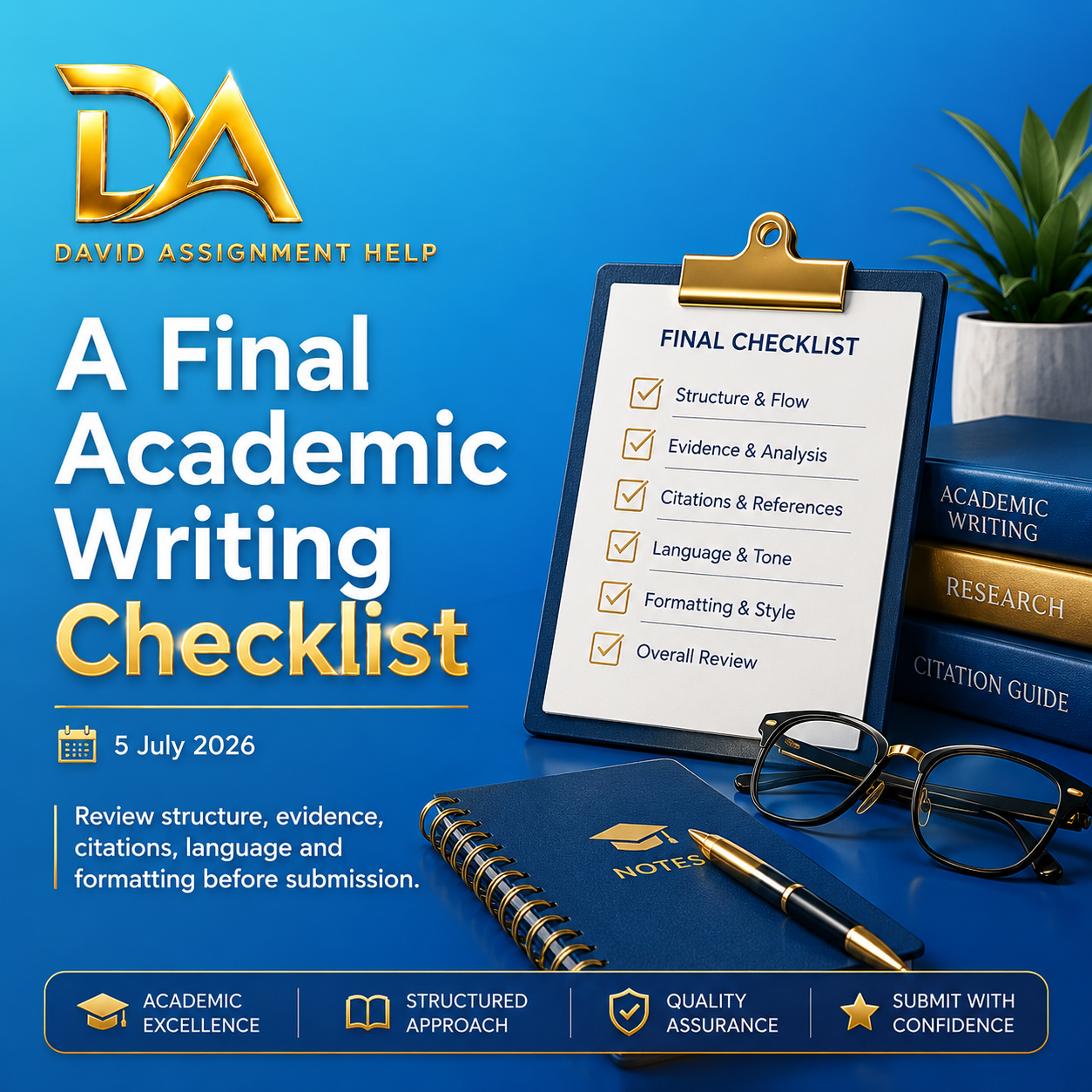
A Final Academic Writing Checklist
Published: 5 July 2026
Finishing the first draft does not mean an assignment is ready for submission.
The final review stage gives you an opportunity to identify missing evidence, unclear arguments, citation errors and formatting problems. It can also help you improve the overall professionalism of your work.
Use this checklist after completing your draft and before uploading the final file.
1. Confirm that you answered the assignment question
Return to the original assignment brief and read the question again.
Ask yourself:
- Did I answer every part of the question?
- Did I follow the required task words?
- Did I stay within the correct topic and scope?
- Did I focus on the required organisation, industry, country or case?
- Did I provide analysis rather than only description?
- Did I include recommendations when requested?
It is possible to write a well-researched assignment that does not fully answer the question. Make sure every major section contributes directly to the task.
2. Check the marking rubric
Review the assignment against each marking criterion.
Do not assume that a good argument will compensate for missing requirements. A rubric may separately assess:
- Subject knowledge
- Critical analysis
- Research quality
- Application of theory
- Structure
- Referencing
- Language
- Formatting
Identify the criteria with the highest weighting and confirm that your assignment provides enough depth in those areas.
3. Review the overall structure
The assignment should follow a clear and logical order.
Check whether it includes the required sections, such as:
- Title page
- Executive summary
- Table of contents
- Introduction
- Main discussion
- Findings
- Recommendations
- Conclusion
- Reference list
- Appendices
Not every assignment requires all these sections. Follow the assessment instructions rather than using a general template without checking.
Read only the headings and subheadings. They should tell a clear story even without the paragraphs underneath them.
4. Strengthen the introduction
A strong introduction normally explains:
- The topic
- The context
- The purpose of the assignment
- The scope
- The central argument or position
- The structure of the paper
Avoid beginning with very broad statements that do not contribute to the topic.
For example:
Business has always been important throughout human history.
This opening is too general.
A more focused opening would be:
The increasing use of artificial intelligence in digital marketing has changed how retailers communicate with customers, personalise content and manage online engagement.
The introduction should prepare the reader for the discussion that follows.
5. Check each main paragraph
Each paragraph should focus on one central idea.
A strong academic paragraph normally contains:
- A clear topic sentence
- An explanation of the main point
- Relevant evidence
- Analysis or evaluation
- A connection to the assignment question
Check whether any paragraph contains too many unrelated ideas. Long paragraphs may need to be divided. Very short paragraphs may need further development or may need to be combined with a related point.
Also review paragraph transitions. The relationship between ideas should be clear.
Useful linking expressions include:
- In addition
- However
- In contrast
- As a result
- Similarly
- More importantly
- This finding suggests that
- From a practical perspective
- Despite this advantage
Do not overuse the same transition repeatedly.
6. Separate description from analysis
Description explains what happened, what a theory states or what a source found.
Analysis explains why the information matters.
Consider the difference:
Description:
The company introduced a mobile application in 2025.
Analysis:
The application may improve customer convenience by reducing the number of steps required to complete a purchase. However, its effectiveness depends on usability, security and integration with the company's existing loyalty programme.
After presenting information, ask:
- Why is this important?
- What does it demonstrate?
- What are the strengths and weaknesses?
- How does it relate to the theory?
- Does another source agree?
- Are there any limitations?
- How does it apply to the selected case?
These questions help develop critical discussion.
7. Review the evidence
Check whether your main claims are supported by credible sources.
Academic evidence may come from:
- Peer-reviewed journal articles
- Academic books
- Government reports
- Industry publications
- Reliable statistics
- Company reports
- Legislation
- Professional organisations
Be cautious with:
- Anonymous websites
- Promotional blogs
- Unverified social media posts
- Outdated statistics
- Sources without publication dates
- AI-generated references that you have not verified
Make sure the evidence is current enough for the topic. Historical sources may still be appropriate for foundational theories, while market data and legislation often require more recent material.
8. Check the balance of sources
Do not depend too heavily on one author or website.
A strong assignment usually compares information from several sources. Where appropriate, include different viewpoints.
For example:
Smith (2023) argues that personalised advertising improves customer engagement. However, Tran and Lee (2024) found that excessive personalisation may create privacy concerns.
This comparison creates a stronger discussion than repeatedly summarising a single source.
9. Check every in-text citation
Review each citation carefully.
Confirm that:
- The author name is spelled correctly.
- The publication year is correct.
- The citation follows the required style.
- Direct quotations include page numbers when required.
- Multiple sources are ordered correctly.
- Organisation names are presented consistently.
- Every borrowed idea has been acknowledged.
Also check that the citation appears in the correct location. It should be clear which sentence or idea it supports.
10. Compare citations with the reference list
Every in-text citation should have a matching reference-list entry.
Every source in the reference list should normally appear in the assignment.
Check for common inconsistencies:
- Smith (2024) in the text but Smith (2023) in the reference list
- Different spellings of an author's name
- Missing co-authors
- Incorrect article titles
- Incomplete journal details
- Missing DOI or URL
- Incorrect use of italics
- Inconsistent capitalisation
Do not rely entirely on automatic reference generators. They may produce incorrect punctuation, capitalisation or source types.
11. Review quotations
Make sure every direct quotation includes quotation marks and a citation.
Use quotations only when the exact wording is necessary. Too many quotations can make the assignment appear dependent on sources.
After each quotation, explain its relevance. Do not insert a quotation and move directly to a different topic.
12. Check paraphrasing quality
Compare paraphrased sections with the original sources.
A proper paraphrase should:
- Preserve the original meaning
- Use a different sentence structure
- Use natural wording
- Avoid copying distinctive phrases
- Include a citation
Changing a few synonyms is not sufficient.
Also check that your rewritten version has not changed the author's intended meaning.
13. Review the conclusion
The conclusion should bring the assignment together.
It normally:
- Restates the purpose
- Summarises the main findings
- Presents the overall judgement
- Connects back to the assignment question
- Avoids introducing major new evidence
A conclusion should do more than repeat the introduction word for word.
For example:
Overall, digital personalisation can strengthen customer engagement by delivering more relevant content. However, its long-term effectiveness depends on transparent data practices, accurate customer information and an appropriate balance between convenience and privacy.
This sentence summarises the argument and provides a clear final judgement.
14. Check recommendations
When recommendations are required, make sure they are:
- Specific
- Realistic
- Relevant
- Supported by the discussion
- Suitable for the selected organisation or context
Avoid vague recommendations such as:
The company should improve its marketing.
A more practical recommendation would be:
The company should introduce a segmented email strategy that uses recent purchase behaviour to provide relevant product recommendations while allowing customers to adjust their communication preferences.
Recommendations should follow logically from the issues identified in the assignment.
15. Check academic language
Academic writing should be clear, formal and precise.
Review the assignment for:
- Informal expressions
- Slang
- Unsupported personal opinions
- Repetitive wording
- Overly emotional language
- Unnecessary rhetorical questions
- Very long sentences
- Unclear pronouns
- Excessive passive voice
- Incorrect terminology
Replace vague words such as “things”, “a lot”, “good”, “bad” and “big” with more precise language.
For example:
Vague:
The strategy had a big effect on sales.
Improved:
The strategy contributed to a substantial increase in quarterly sales.
However, avoid replacing simple words with unnecessarily complex vocabulary. Clear writing is usually more effective than complicated writing.
16. Check grammar and sentence structure
Look for common grammar problems, including:
- Subject-verb agreement
- Verb tense consistency
- Singular and plural forms
- Articles such as “a”, “an” and “the”
- Prepositions
- Sentence fragments
- Run-on sentences
- Incorrect word forms
- Pronoun reference
- Punctuation errors
Read the assignment aloud. This can help you notice missing words, unnatural sentences and repeated expressions.
17. Check abbreviations and terminology
Write the full term the first time an abbreviation appears.
For example:
Customer relationship management (CRM)
After this, you can use “CRM” consistently.
Check that the same term is not written in several different ways. For example, do not alternate between “e-commerce”, “ecommerce” and “electronic commerce” without a clear reason.
18. Review tables and figures
Check that every table and figure:
- Has a number
- Has a clear title
- Is mentioned in the main text
- Includes a source when required
- Uses readable formatting
- Is placed near the relevant discussion
- Adds useful information
Do not insert a table without explaining its meaning.
For example:
As shown in Table 2, online sales increased steadily between 2023 and 2025, with the largest annual increase occurring in 2025.
The analysis should explain what the data demonstrates.
19. Check formatting
Review the document against the submission requirements.
Check:
- Font style
- Font size
- Line spacing
- Margins
- Page numbers
- Heading styles
- Paragraph spacing
- Text alignment
- File type
- Student number
- Course code
- Lecturer name
- Assignment title
Make sure headings are consistent. Do not use bold text, underlining and different font sizes randomly.
20. Check the word count
Confirm what is included or excluded from the official word count.
Depending on the institution, the word count may exclude:
- Title page
- Table of contents
- Reference list
- Appendices
- Tables
- Figure captions
- Direct quotations
Do not assume these rules are the same for every course.
When reducing the word count, remove:
- Repeated ideas
- Unnecessary background
- Long examples
- Generic statements
- Excessive quotations
- Sentences that do not answer the question
Do not remove essential evidence or analysis only to reach the limit.
21. Check academic integrity
Before submission, confirm that:
- All sources are acknowledged.
- Quotations are clearly marked.
- Paraphrased ideas include citations.
- References are genuine and accessible.
- Data has not been invented.
- You followed the institution's rules about collaboration.
- You followed the institution's rules regarding AI tools.
- You have not reused previous work without permission.
Academic integrity is not only about avoiding copied wording. It also requires honest representation of research, evidence and authorship.
22. Review the similarity report carefully
When a Turnitin report is available, review the highlighted matches.
Focus on:
- Long matching passages
- Uncited text
- Wording that is too close to a source
- Missing quotation marks
- Reused content
- Incorrect paraphrasing
Do not focus only on the total percentage. References, common phrases and required templates may also create matches.
23. Complete a final technical check
Before uploading the assignment:
- Save the final version.
- Use the required filename.
- Confirm that you selected the correct file.
- Open the file after saving it.
- Check that all pages display correctly.
- Confirm that tables and figures have not moved.
- Make sure tracked changes and comments are removed.
- Check that the file is not corrupted.
- Upload before the deadline.
- Save the submission confirmation.
Avoid making major changes immediately before submission unless they are necessary. Last-minute editing can create new errors.
Final submission checklist
Before clicking “Submit”, confirm:
- The assignment answers the full question.
- The structure follows the instructions.
- The main argument is clear.
- Each paragraph has a clear purpose.
- Claims are supported by reliable evidence.
- Analysis is included throughout.
- Citations and references are consistent.
- Quotations and paraphrases are accurate.
- Grammar and language have been checked.
- Tables and figures are correctly presented.
- The word count is appropriate.
- The formatting meets the requirements.
- The correct file is ready for upload.
Final thoughts
A final review can significantly improve the quality of an assignment.
Do not complete every check in one rushed reading. Review the paper in separate stages. First check the argument and structure. Next review the evidence and citations. Finally, check grammar, formatting and technical submission requirements.
A careful final review will not fix weak research or missing analysis automatically, but it can help you present your work clearly, accurately and professionally.