
Turnitin Similarity: What the Percentage Actually Means
Published: 9 July 2026
A Turnitin similarity percentage is often misunderstood. Some students believe that any similarity is plagiarism, while others assume that a low percentage means the assignment is completely safe.
Neither assumption is correct.
The similarity score shows how much of a submitted document matches text found in Turnitin's comparison database. It does not automatically determine whether plagiarism has occurred. The report must be reviewed carefully to understand why the matches appear and whether they represent a genuine academic-integrity concern.
What does the Turnitin similarity percentage show?
When a document is submitted, Turnitin compares its text with available sources in its database. These sources may include:
- Websites
- Online publications
- Journal articles
- Books
- Previously submitted student papers
- Institutional repositories
- Other published materials
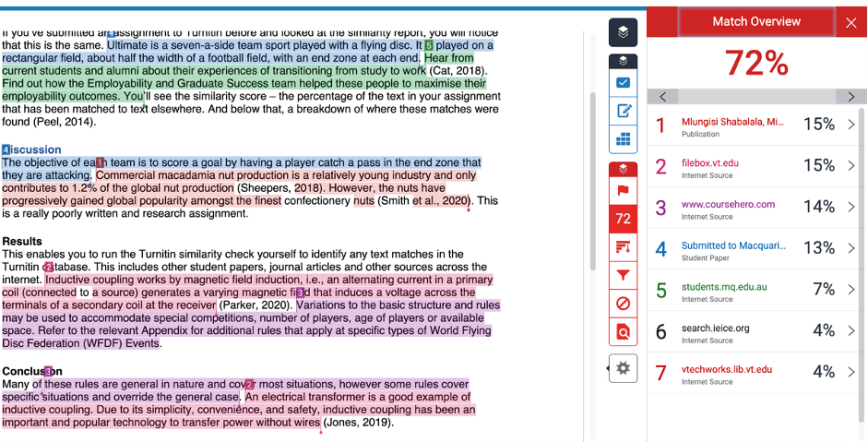
Turnitin then highlights matching text and produces an overall similarity percentage.
For example, a similarity score of 18% means that approximately 18% of the submitted text matches content found in Turnitin's database.
However, this does not mean that 18% of the assignment has been plagiarised.
Some matches may be correctly quoted, properly cited or unavoidable.
Similarity is not the same as plagiarism
Plagiarism involves presenting another person's words, ideas or work as your own without appropriate acknowledgement.
Similarity simply means that Turnitin has identified matching or closely related text.
A document may have a relatively high similarity score without containing serious plagiarism. For example, the report may include:
- A long reference list
- Correctly formatted direct quotations
- Standard definitions
- Assignment questions
- Common technical phrases
- Legal provisions
- Survey questions
- Templates provided by the university
At the same time, a paper with a low overall score may still contain a serious issue. A student could copy one important paragraph without citation, but the overall percentage may remain low because the rest of the document is original.
The percentage should therefore be treated as a starting point for review, not a final judgement.
Is there a safe similarity percentage?
There is no universal Turnitin percentage that is automatically acceptable for every assignment.
Universities, courses and lecturers may apply different expectations. Acceptable similarity may also depend on:
- The subject area
- The assignment type
- The word count
- The amount of quoted material
- The required template
- The use of legislation or technical terminology
- Whether references are included in the report
- The institution's academic-integrity policy
For example, a legal assignment may contain repeated names of legislation and legal provisions. A scientific report may use standard technical descriptions. A literature review may contain more citations and source-based discussion than a reflective journal.
Instead of asking only, “Is 15% acceptable?”, ask:
- What sections are matching?
- Are the sources acknowledged?
- Are the matched phrases necessary?
- Is the wording too close to the original?
- Does the paper demonstrate independent analysis?
What should be reviewed in a similarity report?
1. Large matching blocks
Long highlighted sections deserve careful attention, particularly when they match one source.
A large block of matching text may indicate:
- Direct copying
- Incomplete paraphrasing
- Missing quotation marks
- Overuse of quotations
- Reuse of previously submitted work
Review whether the source has been cited and whether the wording needs to be rewritten.
2. Matches without citations
A sentence may include a citation but still be too close to the source. However, matching text without any citation is generally more concerning.
Check whether the information came from another author and whether acknowledgement is required.
3. Patchwriting
Patchwriting occurs when a writer makes small changes to a source while keeping its original sentence structure.
For example:
Source wording:
Effective leadership contributes to employee motivation by creating a supportive and goal-oriented workplace.
Weak rewrite:
Good leadership contributes to staff motivation by developing a supportive and goal-focused work environment.
Although some words have changed, the sentence remains very close to the original.
A stronger paraphrase would change both the wording and the structure:
Employees may become more motivated when leaders provide clear direction, practical support and a positive working environment.
The source should still be cited because the idea is not original.
4. Correct quotations
Direct quotations may appear as matches even when they are correctly used.
A quotation should normally include:
- Quotation marks
- An in-text citation
- A page number when required
- A complete reference-list entry
Quotations should be used selectively. An assignment containing too many direct quotations may demonstrate limited understanding, even when the citations are correct.
5. The reference list
Titles of books, journal articles and websites commonly match existing sources. This is expected because references must reproduce publication details accurately.
Some Turnitin settings allow the bibliography to be excluded from the similarity score. However, the exclusion settings used by students may not be identical to those used by lecturers.
6. Common phrases
Short academic phrases may appear as matches, including:
- “The findings of this study indicate that”
- “Based on the results presented above”
- “There are several factors that influence”
- “The purpose of this report is to”
These phrases are not usually a serious concern by themselves. However, repeated use of generic language may make the writing sound formulaic.
7. Assignment templates and questions
Students may be required to include:
- Assessment questions
- Cover-page text
- Declaration statements
- Table headings
- Provided case-study information
- Standard report templates
These sections may create similarity even though the student was instructed to use them.
Why can the similarity score change?
A similarity percentage may change after submission for several reasons.
The document may be compared with new material added to the database. Different report settings may also include or exclude:
- References
- Direct quotations
- Small matches
- Individual sources
- Previously submitted drafts
A resubmitted assignment may sometimes match an earlier version of the same document, depending on how the institution has configured its submission system.
This is one reason students should not focus only on achieving a specific number.
Should you try to reduce the score to 0%?
A 0% similarity score is not always necessary or realistic.
Academic writing naturally contains:
- Citations
- Reference details
- Names of theories
- Technical terminology
- Official titles
- Common academic expressions
Trying to force the report to 0% may lead to awkward writing or inaccurate paraphrasing. Students may replace necessary terminology with unsuitable synonyms, weaken definitions or change the original meaning.
The goal should be academic integrity and clear writing, not an artificially perfect number.
How to reduce problematic similarity properly
Understand the source before rewriting
Do not rewrite one sentence at a time while looking directly at the source. Read the whole section, identify the main idea, close the source and explain the idea in your own structure.
Change the sentence structure
Effective paraphrasing involves more than replacing individual words.
You may:
- Combine related sentences
- Split a long sentence
- Change the order of ideas
- Change the focus of the sentence
- Summarise several sentences into one
- Explain the idea through the assignment context
Add your own analysis
Similarity often becomes high when an assignment relies heavily on source summaries.
After presenting evidence, explain:
- Why the evidence matters
- How it relates to the topic
- Whether it has limitations
- How it applies to the selected case
- Whether another source supports or challenges it
Your analysis helps distinguish your academic contribution from the material collected from sources.
Use quotations only when necessary
Quote the source directly when the exact wording is important, distinctive or difficult to reproduce accurately.
For most general ideas, paraphrasing is more appropriate.
Cite every borrowed idea
Changing the wording does not remove the need for citation.
A citation is required when you use another source's:
- Theory
- Definition
- Argument
- Finding
- Data
- Model
- Interpretation
- Specific example
A practical Turnitin review process
Before submission, review the report in this order:
- Check the largest matches.
- Review matches connected to a single source.
- Identify uncited or incorrectly cited material.
- Rewrite sections that follow the source too closely.
- Confirm that quotations use quotation marks and citations.
- Check whether references or templates explain some of the percentage.
- Review your paraphrasing against the original source.
- Make sure your own analysis is clear.
- Check your university's academic-integrity requirements.
- Proofread the final version after making changes.
Final thoughts
Turnitin is a text-matching system, not an automatic plagiarism judge.
The overall percentage provides useful information, but it cannot explain the academic context of every match. A similarity report should be interpreted by examining the highlighted text, the source, the citation and the purpose of the wording.
Instead of focusing only on reducing the number, focus on using sources responsibly. Proper citation, accurate paraphrasing, selective quotation and independent analysis are more important than reaching a particular percentage.